
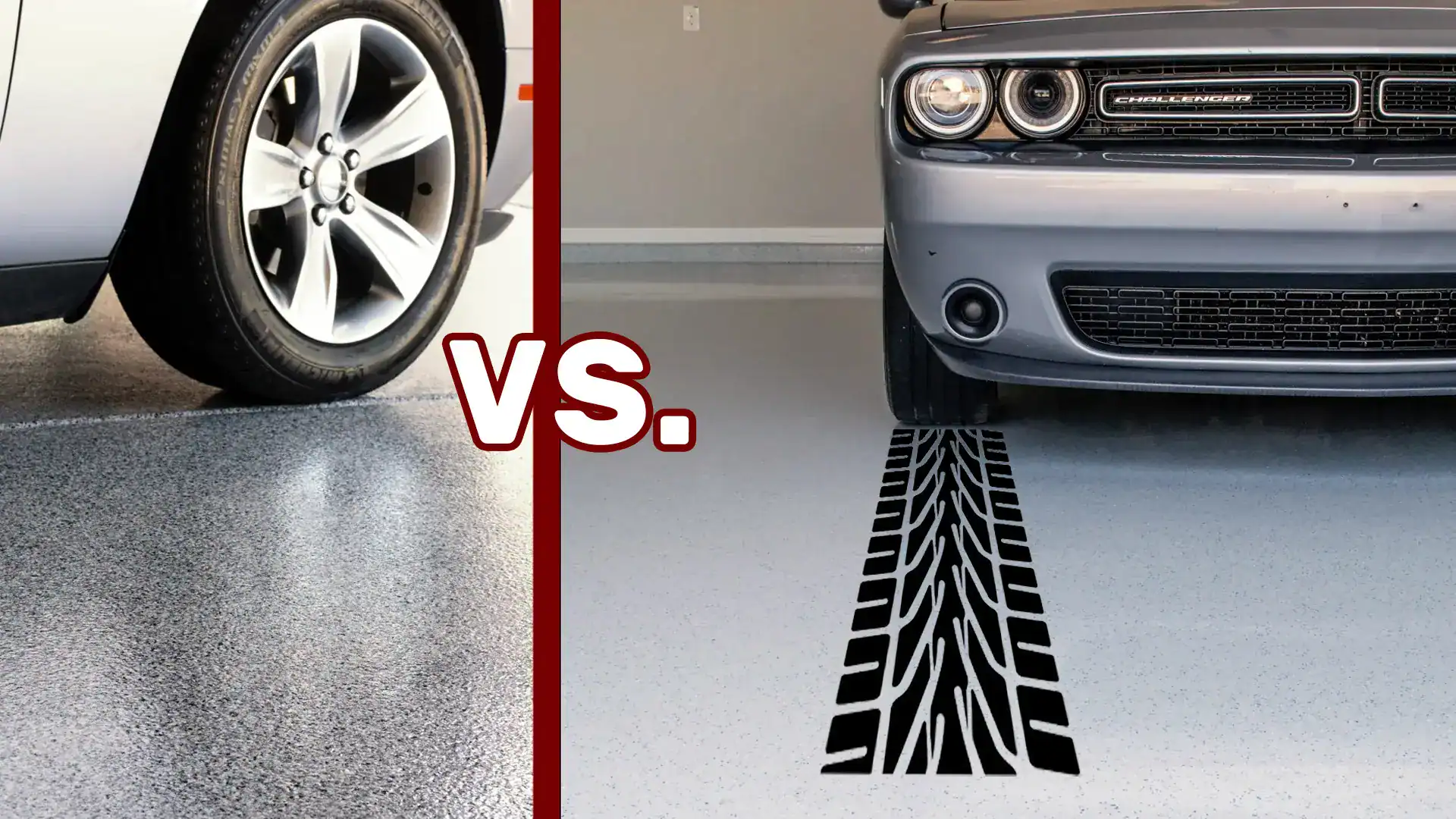
Hot tire transfer is one of the most overlooked reasons garage floor coatings fail. Many homeowners only notice it after tire marks, discoloration, or peeling begin to show. The truth is, not all polyaspartic floor coatings are built to handle it.
Myth: Hot Tire Transfer Requires Extreme Heat
It happens more easily than most people think.
Try this. Feel your tires before you head out. Then check them again after a short drive. Even minimal friction from the road can significantly warm the surface.
Car tires contain plasticizers that keep rubber flexible. As tires heat up, these softening agents migrate to the surface. Once parked, the plasticizers can transfer from the tires into the garage concrete, leaving behind tread marks, and discoloration. If there is an existing floor coating, it may even begin to peel.
Myth: All Polyaspartic Floor Coatings Offer the Same Protection
Many 1-day systems use lower-quality polyurea or polyaspartic coatings that do not densely cross-link (typical of 1:1 mix ratio polyaspartics) and are less than 100%-solids. In “1-day” coating systems, these polyurea-polyaspartics are applied as both (a) the direct-to-concrete primer coat (a terrible idea given that these coatings are very poor moisture vapor barriers), and (b) as the single, clear top coat.
Yet even as clear top coats, poor quality polyaspartics are far more susceptible to hot tire transfer. This is evident in the “1-day” installer’s warranty. They often exclude hot tire transfer (aka plasticizer migration) or recommend using vehicle pads! That raises a simple question. What is the coating actually protecting?
Reality: A 2-Day Polyaspartic Floor Coating System Holds Up
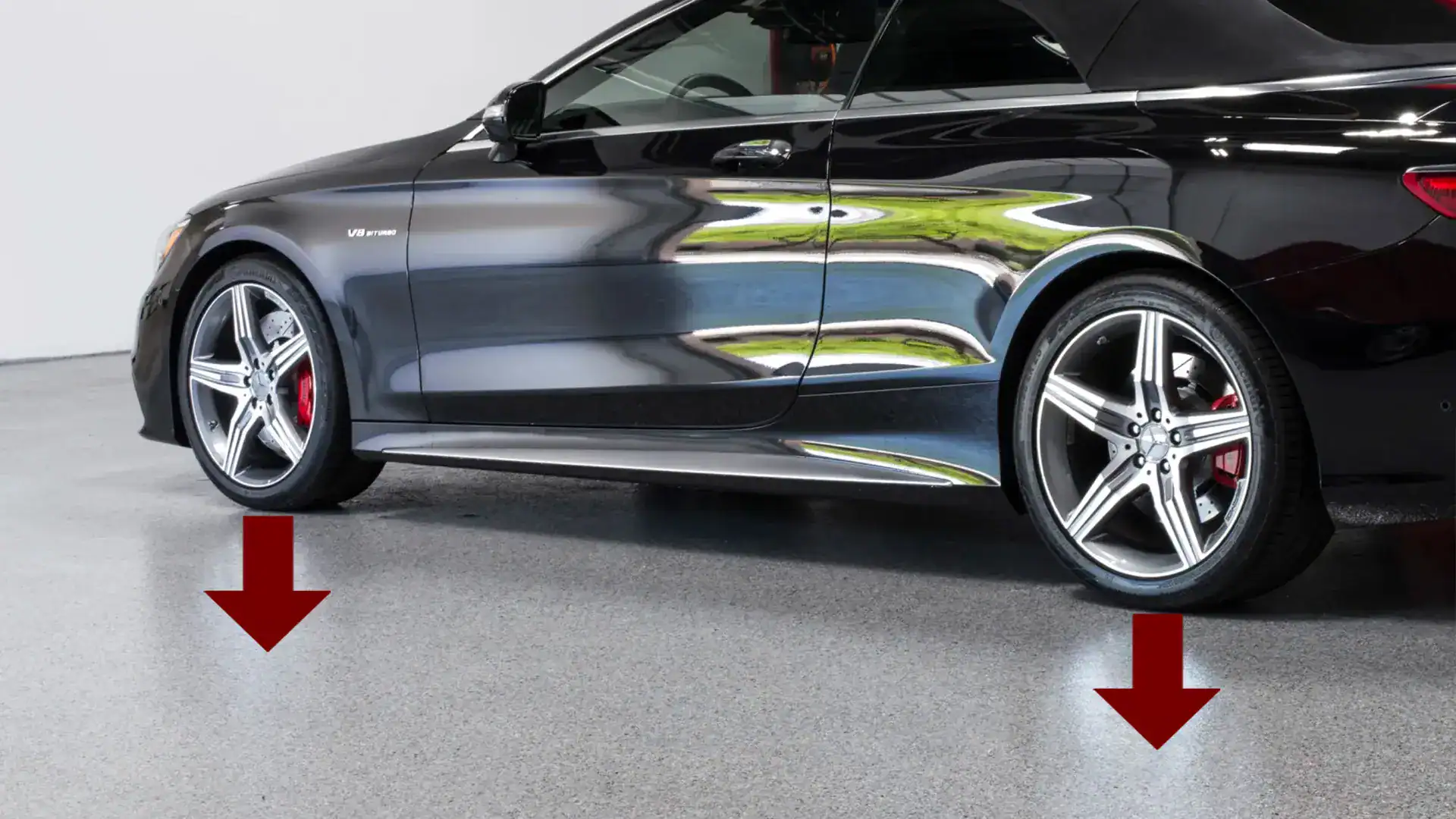
At Garage Floor Coating Inland NW, we install a 2-day system. Our hybrid epoxy and polyaspartic concrete floor coating systems emphasize durability with proper preparation, layering, and quality 100%-solids coatings. We provide quality over speed!
Day one of installation includes mechanical grinding to open the concrete surface. Then, a high-build, moisture-mitigating, 100%-solids epoxy base coat is applied as a moisture vapor barrier (this is missing in “1-day” systems). Into this thick primer coat, the customer-chosen flake blend is broadcast in a full flake spread, embedding into the base layer. The epoxy base coat is allowed to curer overnight for deep penetration into the porous concrete.
On Day two, two separate 100%-solids, high cross-linking (3:2 mix ratio), clear polyaspartic coats are applied, creating a dense, UV-stable surface that resists heat, pressure, chemical exposure…and, of course, hot tire transfer.
Reality: The Right System Prevents the Problem
A properly installed polyaspartic floor coating prevents hot tire pickup, resists staining, and maintains its appearance over time.
In the Inland Northwest, where temperature swings and seasonal conditions can impact concrete, that level of protection makes a difference.
Contact Garage Floor Coating Inland NW today to learn more about a polyaspartic floor coating system designed to stop hot tire transfer before it starts.